 Add to Chrome
 Add to Firefox
 Add to Edge
Automated Random Embedding for Practical Bayesian Optimization with Unknown Effective Dimension
May 25, 2026
Bayesian optimization is widely employed for optimizing complex black-box functions but struggles with the curse of dimensionality. Random embedding, as a dimension reduction strategy, simplifies tasks that possess the effective dimension by optimizing within a low-dimensional subspace. However, determining the effective dimension of a task in advance remains a significant challenge, which influences the selection of the subspace dimensionality and the optimization performance. Traditional methods use fixed subspace dimensions provided by experts or rely on trial and error to estimate subspace dimensions with resources consumed. To this end, this paper proposes an automated random embedding for high-dimensional Bayesian optimization with unknown effective dimension, called Dynamic Shared Embedding Bayesian Optimization (DSEBO). DSEBO starts with a low dimension and switches to a higher subspace if the solutions in the current subspace show preliminary convergence. DSEBO dynamically determines the dimension of the next subspace based on the quality of the solutions in different subspaces and shares the queried solutions with the new subspace for a better initialization. Theoretically, we derive a regret bound for DSEBO and demonstrate that DSEBO can better balance approximation and optimization errors. Extensive experiments on functions with dimensionality of varying magnitudes and real-world tasks with unknown effective dimensions reveal that, compared with state-of-the-art methods, alternating optimization across different subspaces results in significant improvements in high-dimensional optimization, both in terms of optimization regret and time.

From Prediction to Justification: Aligning Sentiment Reasoning with Human Rationale via Reinforcement Learning
Apr 15, 2026While Aspect-based Sentiment Analysis (ABSA) systems have achieved high accuracy in identifying sentiment polarities, they often operate as "black boxes," lacking the explicit reasoning capabilities characteristic of human affective cognition. Humans do not merely categorize sentiment; they construct causal explanations for their judgments. To bridge this gap, we propose ABSA-R1, a large language model framework designed to mimic this ``reason-before-predict" cognitive process. By leveraging reinforcement learning (RL), ABSA-R1 learns to articulate the why behind the what, generating natural language justifications that ground its sentiment predictions. We introduce a Cognition-Aligned Reward Model (formerly sentiment-aware reward model) that enforces consistency between the generated reasoning path and the final emotional label. Furthermore, inspired by metacognitive monitoring, we implement a performance-driven rejection sampling strategy that selectively targets hard cases where the model's internal reasoning is uncertain or inconsistent. Experimental results on four benchmarks demonstrate that equipping models with this explicit reasoning capability not only enhances interpretability but also yields superior performance in sentiment classification and triplet extraction compared to non-reasoning baselines.
APEX: Learning Adaptive Priorities for Multi-Objective Alignment in Vision-Language Generation
Jan 10, 2026Multi-objective alignment for text-to-image generation is commonly implemented via static linear scalarization, but fixed weights often fail under heterogeneous rewards, leading to optimization imbalance where models overfit high-variance, high-responsiveness objectives (e.g., OCR) while under-optimizing perceptual goals. We identify two mechanistic causes: variance hijacking, where reward dispersion induces implicit reweighting that dominates the normalized training signal, and gradient conflicts, where competing objectives produce opposing update directions and trigger seesaw-like oscillations. We propose APEX (Adaptive Priority-based Efficient X-objective Alignment), which stabilizes heterogeneous rewards with Dual-Stage Adaptive Normalization and dynamically schedules objectives via P^3 Adaptive Priorities that combine learning potential, conflict penalty, and progress need. On Stable Diffusion 3.5, APEX achieves improved Pareto trade-offs across four heterogeneous objectives, with balanced gains of +1.31 PickScore, +0.35 DeQA, and +0.53 Aesthetics while maintaining competitive OCR accuracy, mitigating the instability of multi-objective alignment.
Boosting Large Language Models with Continual Learning for Aspect-based Sentiment Analysis
May 09, 2024Aspect-based sentiment analysis (ABSA) is an important subtask of sentiment analysis, which aims to extract the aspects and predict their sentiments. Most existing studies focus on improving the performance of the target domain by fine-tuning domain-specific models (trained on source domains) based on the target domain dataset. Few works propose continual learning tasks for ABSA, which aim to learn the target domain's ability while maintaining the history domains' abilities. In this paper, we propose a Large Language Model-based Continual Learning (\texttt{LLM-CL}) model for ABSA. First, we design a domain knowledge decoupling module to learn a domain-invariant adapter and separate domain-variant adapters dependently with an orthogonal constraint. Then, we introduce a domain knowledge warmup strategy to align the representation between domain-invariant and domain-variant knowledge. In the test phase, we index the corresponding domain-variant knowledge via domain positioning to not require each sample's domain ID. Extensive experiments over 19 datasets indicate that our \texttt{LLM-CL} model obtains new state-of-the-art performance.
Heterogeneous Directed Hypergraph Neural Network over abstract syntax tree (AST) for Code Classification
May 10, 2023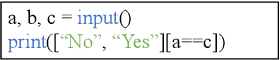
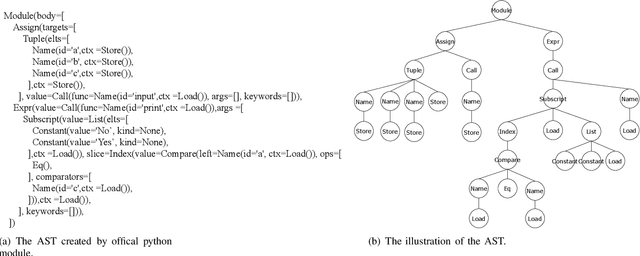
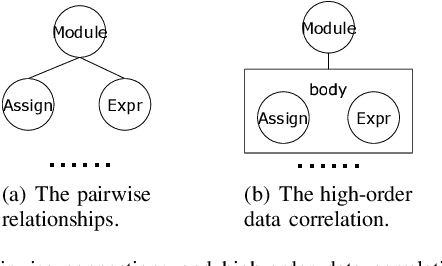
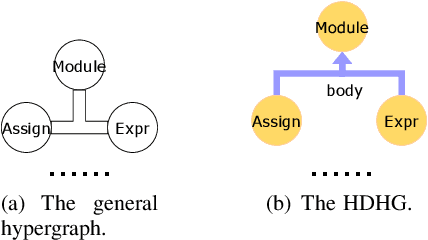
Code classification is a difficult issue in program understanding and automatic coding. Due to the elusive syntax and complicated semantics in programs, most existing studies use techniques based on abstract syntax tree (AST) and graph neural network (GNN) to create code representations for code classification. These techniques utilize the structure and semantic information of the code, but they only take into account pairwise associations and neglect the high-order correlations that already exist between nodes in the AST, which may result in the loss of code structural information. On the other hand, while a general hypergraph can encode high-order data correlations, it is homogeneous and undirected which will result in a lack of semantic and structural information such as node types, edge types, and directions between child nodes and parent nodes when modeling AST. In this study, we propose to represent AST as a heterogeneous directed hypergraph (HDHG) and process the graph by heterogeneous directed hypergraph neural network (HDHGN) for code classification. Our method improves code understanding and can represent high-order data correlations beyond paired interactions. We assess heterogeneous directed hypergraph neural network (HDHGN) on public datasets of Python and Java programs. Our method outperforms previous AST-based and GNN-based methods, which demonstrates the capability of our model.